 Add to Chrome
 Add to Firefox
 Add to Edge
Quantizing Intent: Cross-Domain Semantic IDs from Organic Activity for Industrial Ranking
May 31, 2026
Ads click-through rate (CTR) prediction is constrained by sparse user supervision: most users engage with ads infrequently while generating dense behavioral evidence in organic surfaces such as feed. Transferring these cross-domain signals into ads ranking is difficult due to domain mismatch, serving cost, and production complexity. We introduce cross-domain user Semantic IDs (SIDs) derived from organic feed activity and show that behavioral activity richness governs cross-domain transfer quality: SIDs from user profile text yield +0.036% AUC, SIDs from an activity-tuned LLaMA-based user embedding model yield +0.107%, and SIDs from direct feed activity behavioral embeddings yield +0.213%. We further propose RQ-FSQ, a residual finite scalar quantization method that discretizes pre-trained embeddings while matching dense-embedding AUC at substantially smaller storage. Across two heterogeneous sources, RQ-FSQ matches or slightly exceeds dense source embeddings, achieving +0.351% AUC for Feed Activity at about 30x smaller storage and +0.265% AUC for Activity-Tuned LLaMA at about 280x smaller storage. We also introduce a Hierarchical Discrete Embedding module that encodes multi-level SIDs through prefix n-gram sparse embedding tables trained end-to-end under the CTR objective. In a large-scale industrial ads ranking system, cold-start segment analysis shows gains up to +1.522% for users with near-zero ad interaction history, validating cross-domain behavioral transfer as an effective bridge for sparse-history ranking.

An Industrial-Scale Sequential Recommender for LinkedIn Feed Ranking
Feb 12, 2026LinkedIn Feed enables professionals worldwide to discover relevant content, build connections, and share knowledge at scale. We present Feed Sequential Recommender (Feed-SR), a transformer-based sequential ranking model for LinkedIn Feed that replaces a DCNv2-based ranker and meets strict production constraints. We detail the modeling choices, training techniques, and serving optimizations that enable deployment at LinkedIn scale. Feed-SR is currently the primary member experience on LinkedIn's Feed and shows significant improvements in member engagement (+2.10% time spent) in online A/B tests compared to the existing production model. We also describe our deployment experience with alternative sequential and LLM-based ranking architectures and why Feed-SR provided the best combination of online metrics and production efficiency.
BanditLP: Large-Scale Stochastic Optimization for Personalized Recommendations
Jan 22, 2026We present BanditLP, a scalable multi-stakeholder contextual bandit framework that unifies neural Thompson Sampling for learning objective-specific outcomes with a large-scale linear program for constrained action selection at serving time. The methodology is application-agnostic, compatible with arbitrary neural architectures, and deployable at web scale, with an LP solver capable of handling billions of variables. Experiments on public benchmarks and synthetic data show consistent gains over strong baselines. We apply this approach in LinkedIn's email marketing system and demonstrate business win, illustrating the value of integrated exploration and constrained optimization in production.
Beyond Basic A/B testing: Improving Statistical Efficiency for Business Growth
May 13, 2025The standard A/B testing approaches are mostly based on t-test in large scale industry applications. These standard approaches however suffers from low statistical power in business settings, due to nature of small sample-size or non-Gaussian distribution or return-on-investment (ROI) consideration. In this paper, we propose several approaches to addresses these challenges: (i) regression adjustment, generalized estimating equation, Man-Whitney U and Zero-Trimmed U that addresses each of these issues separately, and (ii) a novel doubly robust generalized U that handles ROI consideration, distribution robustness and small samples in one framework. We provide theoretical results on asymptotic normality and efficiency bounds, together with insights on the efficiency gain from theoretical analysis. We further conduct comprehensive simulation studies and apply the methods to multiple real A/B tests.
Neural Optimization with Adaptive Heuristics for Intelligent Marketing System
May 17, 2024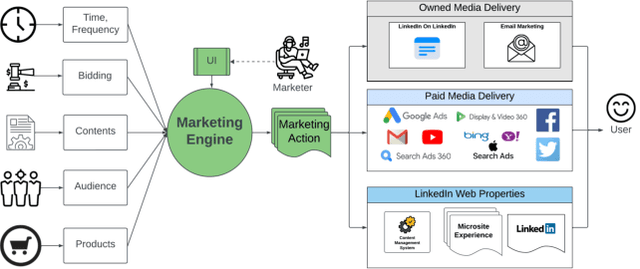
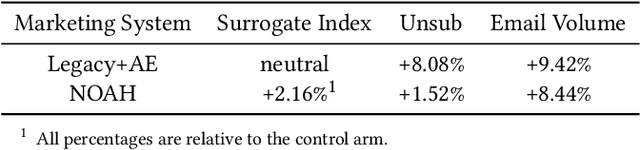
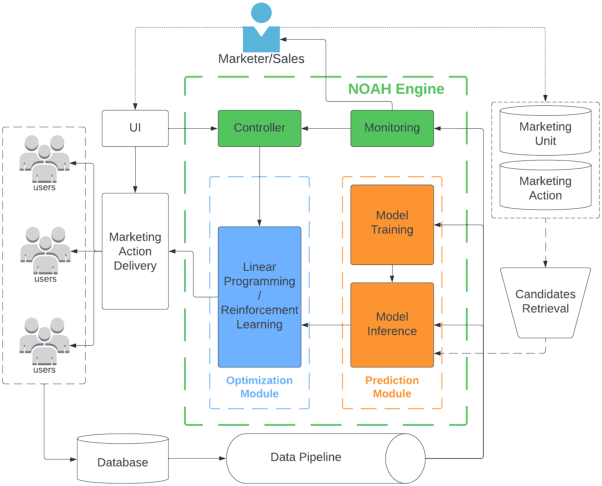

Computational marketing has become increasingly important in today's digital world, facing challenges such as massive heterogeneous data, multi-channel customer journeys, and limited marketing budgets. In this paper, we propose a general framework for marketing AI systems, the Neural Optimization with Adaptive Heuristics (NOAH) framework. NOAH is the first general framework for marketing optimization that considers both to-business (2B) and to-consumer (2C) products, as well as both owned and paid channels. We describe key modules of the NOAH framework, including prediction, optimization, and adaptive heuristics, providing examples for bidding and content optimization. We then detail the successful application of NOAH to LinkedIn's email marketing system, showcasing significant wins over the legacy ranking system. Additionally, we share details and insights that are broadly useful, particularly on: (i) addressing delayed feedback with lifetime value, (ii) performing large-scale linear programming with randomization, (iii) improving retrieval with audience expansion, (iv) reducing signal dilution in targeting tests, and (v) handling zero-inflated heavy-tail metrics in statistical testing.